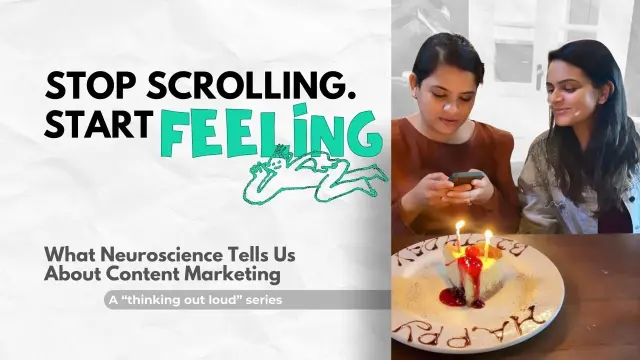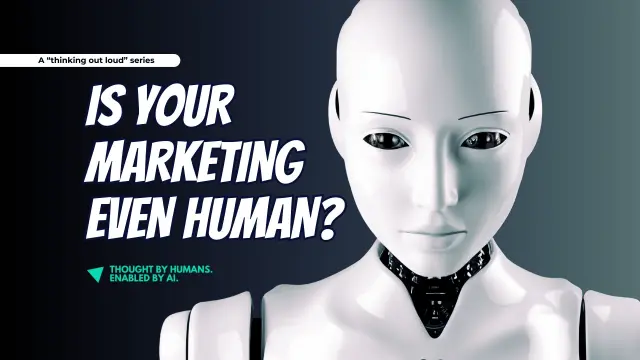
It’s a question of whether you’ve outsourced your brain, your heart, or both. It may sound harsh, but the recent MIT study highlights something crucial for anyone leaning heavily on AI. Researchers used EEG scans to compare students writing essays with ChatGPT vs. those thinking independently. They found:
- Reduced neural engagement: The ChatGPT-assisted group showed significantly lower brain activity during writing.
- Poorer retention & performance: Over time, those relying on AI scored lower and remembered less (m.economictimes.com).
This suggests a troubling trend: with excessive AI dependence, our brains are shifting to passive consumption, sacrificing creativity, emotional depth, and critical thinking.
In the context of Marketing, over-AI means under-engaged—your audience’s minds drift, they don’t remember, they don’t connect.
What to do Instead?
It’s fairly simple: Add a Human-first layer to the AI generated content.
- Humans who understand your story and your culture, drive the narrative.
- Empowered by AI to iterate faster, test deeper, execute smarter.
- Measured by results that matter—audience impact, memory retention, business outcomes
Lately, I repeatedly received AI generated narratives, storylines, even entire website communication for execution. Flawlessly generated content— And I often ask to myself — Does it capture your brand’s heart, your founder’s vision, your audience’s aspirations? AI can help craft structure—and speed—but it’s your marketers, grounded in strategy, culture, and emotion, that breathe life into it.
Thought by Humans, Enabled by AI — The Strategic Imperative for Indian Marketers
India’s cultural landscape is rich and varied—from regional dialects to festival traditions, from Bollywood nostalgia to cricket camaraderie. You can’t automate that. A human-first approach means:
- Embedding cultural intelligence: Writers, strategists, and creators attuned to your audience’s emotional codes.
- Emotion‑first storytelling: Content that triggers empathy, mirroring the neural synapses our brains fire when we relate.
- Strategic framing + AI execution: Humans define the story’s architecture; AI scales it.
An Example of Human + AI Manifesto on a Current Project in Action: We start with client insight—say, a founder’s journey through India’s startup ecosystem. Humans map the emotional beats; AI generates multiple draft styles. Humans refine tone, pacing, cultural touchpoints; AI powers visuals and multi-channel adaptation.
Final output? Real, robust, relatable—and ready to scale.
If your content is created by AI and not activated by human strategic thinking, it’s unlikely to engage deeply—or move your audience. So ask yourself:
- Are your campaigns born from data alone, or from real conversations with your audience?
- Does your content echo your brand’s soul—or just the latest trend?
- Are your outputs building connections—or just filling feeds?
If the answer leans toward templated automation, it’s time to bring back the human-led strategy.
This article is part of my “Thinking Out Loud” series — written for founders, marketers, and investors who believe that strategy isn’t optional, storytelling isn’t fluff, and AI is only as good as the human behind it.
If your content echoes the latest trend but not your brand’s soul — or you know a founder who’s quietly struggling with template fatigue — forward this to them.
👉 Don’t just build content. Build conviction. Because the internet has enough noise. What it needs is truth with a point of view.